
What is a Second Mortgage Loan? How can You Access the Money?
Table of Contents
Your home could be worth more than you think, and not just as a place to live. But first, let’s answer the question, ‘What is a second mortgage loan?’
For many New Zealand homeowners, years of mortgage repayments and rising property values have quietly built up a significant financial asset. A second mortgage lets you put that equity to work without giving up your existing home loan or the interest rate that came with it.
Whether you need funds for a renovation, a business cash flow gap, or a deposit top-up, a second mortgage could be the tool you didn’t know you had access to.
This guide covers everything you need to know, what a second mortgage is, how it works, what it costs, and whether it’s the right move for your situation.
How Do You Use a Second Mortgage Loan?
A second mortgage lets you tap into that value without touching your existing home loan.
When you buy a home and take out a mortgage, your lender holds a “first charge” over your property. A second mortgage is an additional loan registered against the same property, ranked below your original mortgage in priority. If you ever couldn’t repay and your home was sold, the first mortgage lender gets paid out first, then the second mortgage lender.
Because second mortgage lenders take on more risk this way, they typically charge higher interest rates than your main bank. In New Zealand, rates generally start from around 9.95% and are usually offered by non-bank lenders rather than the major banks.
The amount you can borrow depends on your equity. Most lenders will approve a second mortgage up to a combined loan-to-value ratio (LVR) of 75–80%. So if your home is worth $800,000 and you still owe $500,000 on your first mortgage, you may be able to access up to $140,000.
These loans are designed to be short-term. Most run between six months and five years. Unlike refinancing, a second mortgage leaves your existing home loan completely untouched. That means you keep your current interest mortgage rates and terms, which matters a lot if you locked in a good rate you’d rather not lose.
When Does it Make Sense to Access the Equity in Your Home?
A second mortgage isn’t a one-size-fits-all product, but it does solve a surprisingly wide range of financial problems.
Here are some of the most common reasons New Zealanders turn to one.
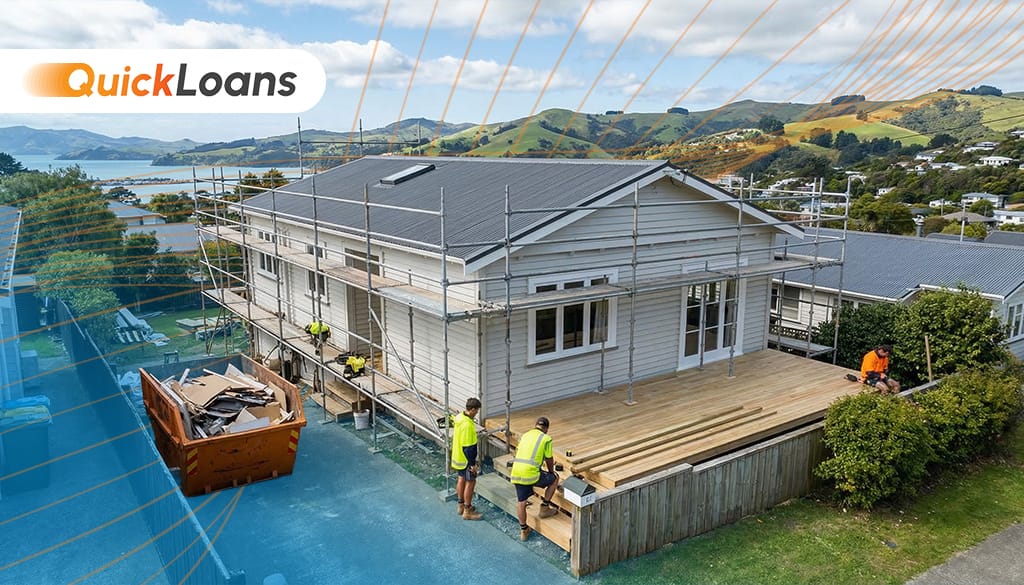
Home Improvement and Renovations
Upgrading your kitchen, adding a bathroom, or building a sleepout can add real value to your property, but those projects aren’t cheap.
A second mortgage lets you fund the work using equity you’ve already built, without disrupting your existing home loan.
Debt Consolidation
Juggling multiple high-interest debts like credit cards, personal loans, or hire purchase agreements gets expensive fast. Rolling them into a second mortgage at a lower rate can reduce what you pay each month and simplify your finances into one manageable repayment.
Business Cash Flow
Business owners sometimes hit short-term cash flow gaps, such as waiting on invoices, covering payroll, or managing a seasonal dip. A second mortgage can provide fast working capital without the lengthy documentation banks often require for business lending.
Paying Tax Arrears
Falling behind on IRD payments is stressful, and the penalties add up quickly. A second mortgage gives business owners and self-employed individuals a way to clear that debt fast, buy some breathing room, and avoid more serious consequences.

Building a Minor Dwelling
Adding a minor dwelling or granny flat to your property can generate rental income and increase its overall value. A second mortgage is a common way to fund this type of development when your main bank won’t extend further credit.
What is a Second Mortgage and How Do You Get One?
Applying for a second mortgage is straightforward. Most non-bank lenders handle everything online, and the process from application to funding can move quickly, sometimes within 24 hours.
You’ll need to provide:
- Photo ID (passport or driver’s licence)
- Proof of income (payslips, bank statements, or tax returns if self-employed)
- Your existing mortgage balance
- A recent rates notice or property valuation
From there, the lender runs a credit check and assesses your equity. Approval can come through in as little as an hour, though complex cases may take up to two business days.
A poor credit history won’t necessarily rule you out, since strong equity can offset the risk in many cases. Once approved, you’ll sign documents digitally. Setup and valuation fees are often added to the loan balance rather than paid upfront.
Example: How a Second Mortgage Works in Practice
Meet Jacqueline. She owns a home in Christchurch valued at $840,000 and still owes $480,000 on her first mortgage. She wants to build a sleep-out to generate rental income, but her bank won’t extend her existing loan.
She applies for a $150,000 second mortgage.
Here’s how it breaks down:
- Property value: $840,000
- First mortgage balance: $480,000
- Second mortgage amount: $150,000
- Combined LVR: 75%
- Interest rate: 11% p.a.
- Loan term: 3 years
- Monthly interest payment: ~$1,375
- Establishment fee: $995
- LINZ mortgage registration: $287.50
- Monthly admin fee: $10
The sleep-out is completed within six months and rents for $400 per week. Over 52 weeks in a year, that’s $20,800 annually, or roughly $1,733 per month (52 weeks ÷ 12 months = 4.33 weeks x $400). That comfortably covers her $1,375 monthly interest repayment, leaving $358 each month in her pocket.
At the end of the 3-year term, Jacqueline has already repaid the $150,000 principal in full. Total interest paid over the loan period comes to $49,500 plus fees. Once the second mortgage is cleared, the full rental income is hers to keep.
Why a Second Home Loan Makes Financial Sense
When used strategically, a second mortgage offers advantages that other borrowing options simply can’t match.
- Your existing mortgage stays untouched – you keep your current interest rate and loan terms without refinancing
- Accessible even with imperfect credit – non-bank lenders weigh property equity over credit history alone
- Fast approval and funding – the assessment and funding process can move within the same business day
- No upfront fees – setup and valuation costs can often be added to the loan balance
- Potential tax advantages – interest may be tax deductible if the loan is used for business purposes
- More affordable than unsecured borrowing – property-secured lending typically carries lower rates than credit cards or personal loans
Second Mortgage vs. Bridging Loan: What’s the Difference?
Both products are short-term, property-secured, and offered by non-bank lenders, so it’s easy to see why people confuse them. But they serve different purposes.
A bridging loan is designed specifically for property transitions. It covers the gap when you’re buying a new home before your existing one sells, with repayment typically tied to that sale.
A second mortgage is broader. It lets you access equity for almost any purpose, from renovations to business costs, while your first mortgage stays in place.
The key distinction comes down to intent. Bridging finance solves a timing problem. A second mortgage solves a funding problem.
| Feature | Second Mortgage | Bridging Loan |
|---|---|---|
| Purpose | Access equity for any use | Cover gap between buying and selling property |
| Repayment trigger | End of loan term | Usually when existing property sells |
| Loan term | 6 months to 5 years | Typically up to 12 months |
| First mortgage | Remains untouched | Often rolled in with bridging loan |
| Exit strategy | Flexible | Must show property sale or refinance plan |
| Best for | Renovations, debt consolidation, business costs | Property purchases with misaligned settlement dates |
If you’re navigating overlapping settlement dates, a bridging loan is the more appropriate tool. If you need funds for a specific goal without touching your existing mortgage, a second mortgage is likely the better fit.
Is a Second Mortgage Right for You?
A second mortgage works best when you have a clear purpose, sufficient equity, and a solid plan to repay it. Used well, it’s a flexible way to access funds quickly without disrupting what you’ve already built with your first mortgage.
The key is going in with realistic expectations. Interest rates are higher than your primary mortgage, the loan term is short, and your property is on the line if repayments fall behind. But for borrowers who’ve done the numbers and have a clear exit strategy, it can be a genuinely practical financial move.

by Ash Horton
02/04/2026
Ash is a professional content writer with extensive experience in business development in the financial services. Ash has founded businesses from the age of 19, including franchising ventures, and working alongside some of the largest retailers in the world.